Background
The problem
Campylobacter and Salmonella are causes of bacterial gastroenteritis.
These infections have a significant economic cost.
New Zealand regularly ranks in the top 3 countries for rates of human Campylobacter infection.
Poultry is a common source of foodborne pathogens, especially Campylobacter.
Emergent resistant strains have been detected in New Zealand.
The Solution
A more holistic approach is needed to tackle foodborne pathogens from retail poultry:
Understanding how the microbiome of the chicken carcass impacts pathogen presence and persistence
Reduction in the time it takes from sample to sequence using Oxford Nanopore technologies and real-time sequencing, which will reduce the time it takes for pathogen detection
Assessing the entire resistome on the chicken carcass in both pathogenic and non-pathogenic bacteria to understand potential transmission
This Project

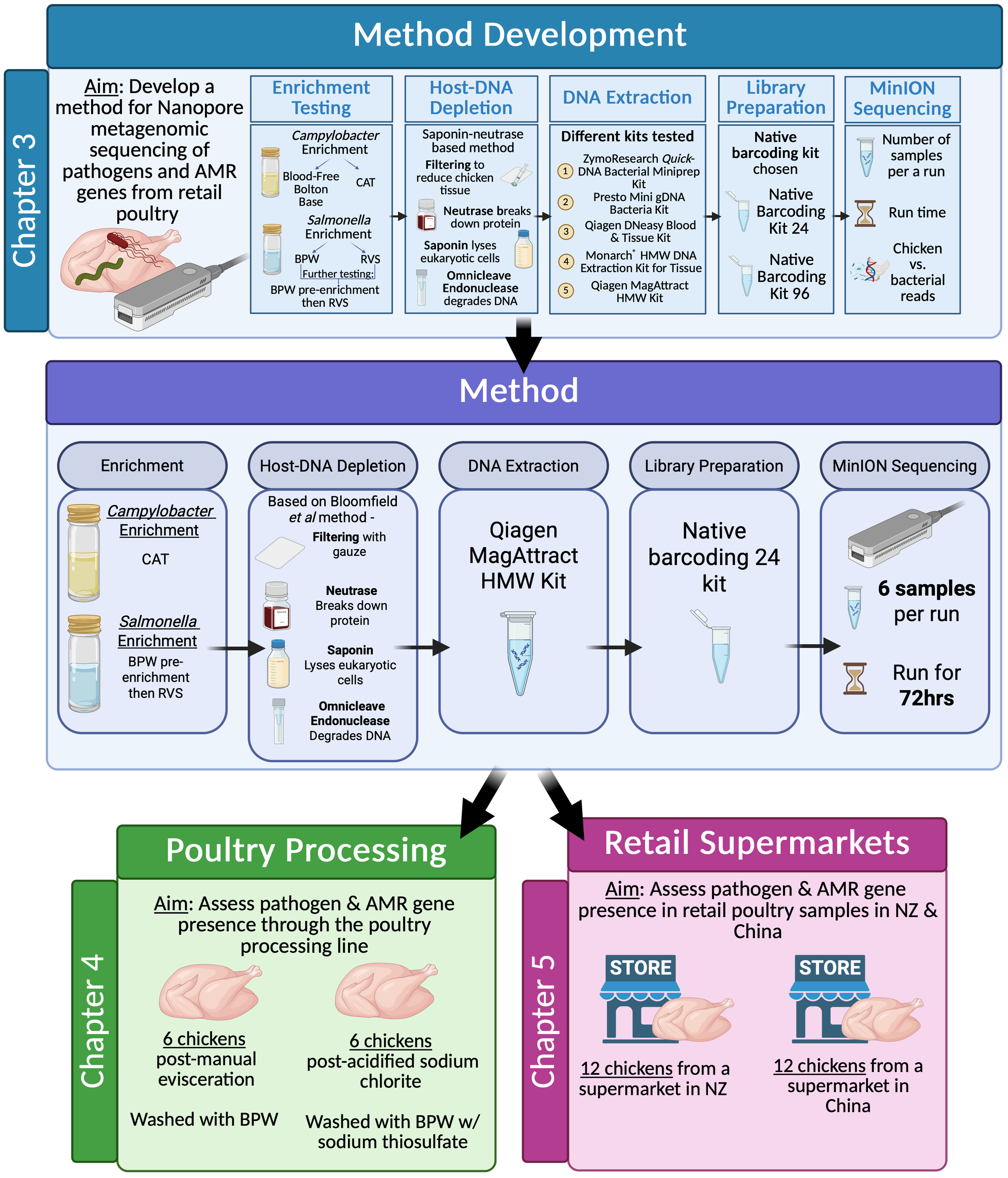
Develop a method for long-read metagenomic sequencing of pathogens and the resistome of retail poultry
Problem: Not enough pathogen DNA present on poultry carcass without enrichment
Solution: Enrichment testing - what is the shortest enrichment time needed to reach levels of pathogen DNA for sequencing while keeping the time from sample to sequence as short as possible?
Problem: High levels of chicken DNA will reduce the number of bacterial reads
Solution: Host-DNA depletion method based on neutrase-saponin methods developed, which will reduce chicken DNA present
Samples enriched for Salmonella, Campylobacter and non-enriched chicken rinse will be barcoded and sequenced using the native barcoding kit on the Oxford Nanopore MinION.